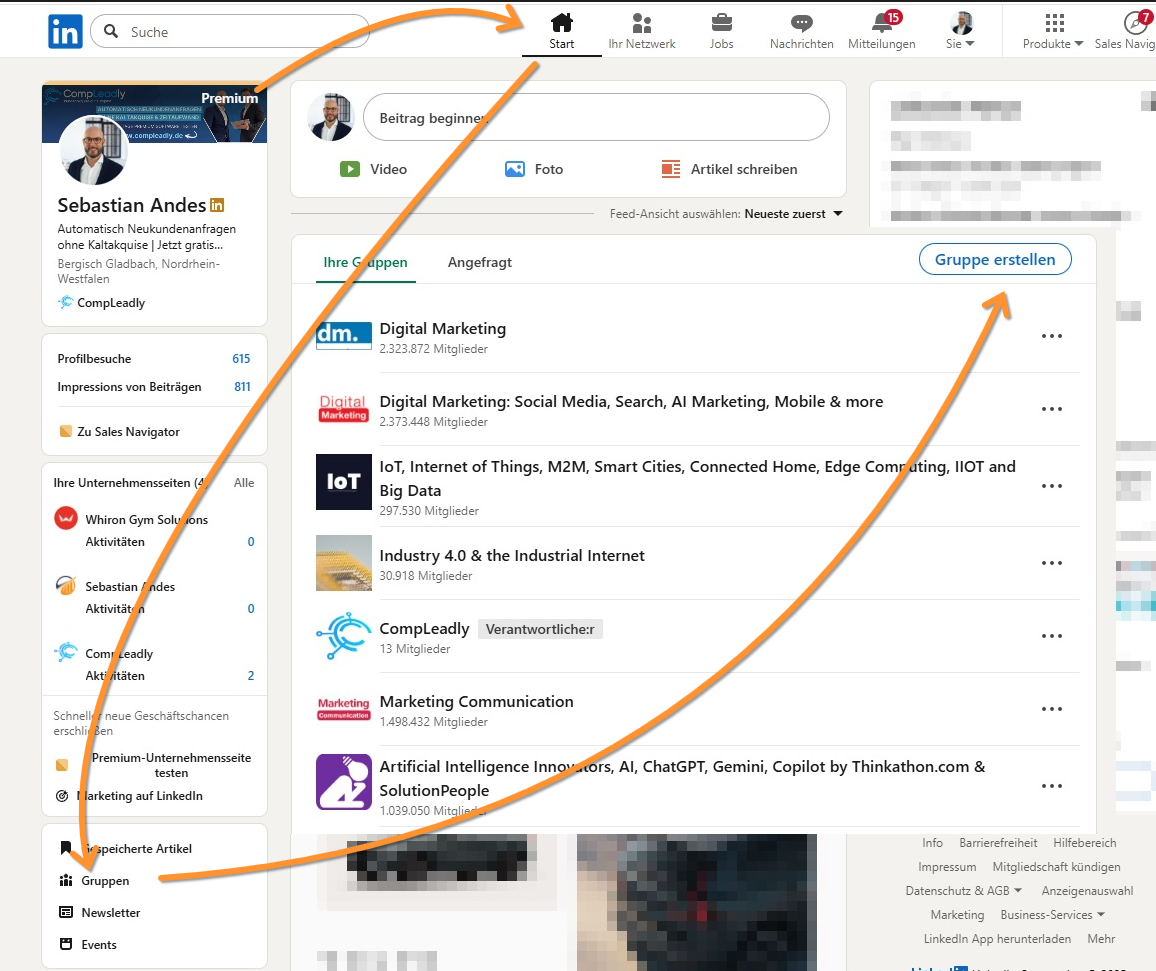
LinkedIn Groups are one of the most underestimated levers on LinkedIn. Used correctly, they give you a steady stream of new conversations, high visibility with your target audience and direct contact without technical barriers. That is exactly why it makes a lot of sense to build your own groups and use them strategically.
LinkedIn allows between 800 and 1,000 group invitations per week. In our experience, at least 10% of these invitations are accepted. Even with just one group, this creates new relevant contacts every week. Running several groups in parallel significantly amplifies this effect.
benefits
The major advantage of having your own group is that you decide:
- which topic takes centre stage
- which target audience is invited
- which rules apply
This creates a controlled space that is tailored exactly to your business.
Use Sales Navigator filters for invitations — only with CompLeadly
By default, LinkedIn only allows very limited filters for group invitations. With CompLeadly, you can overcome this limitation.
First, you filter your desired contacts in Sales Navigator, for example by:
- industry
- job title
- location
- seniority
- degree of connection
You then automatically invite exactly these filtered people to your group. This means your group does not fill up with random profiles, but with the exact people who are relevant to your offer.
Direct messaging — as if you were connected
As soon as someone accepts your group invitation or is a member of the same group as you, you can message them directly. No connection request is required, and no InMail credits are used. Technically, LinkedIn treats group members almost like first-degree connections.
This gives you a major advantage: you can send messages at scale without having to worry about limits, acceptance rates or credits.
Advantage — your own group rules
Another strategic lever lies in the group rules. You can clearly state there that group members may be contacted about specific topics, for example:
- specialist topics related to your business
- invitations to content, events or resources
- This can create an opt-in. Members know what to expect and accept these exact terms when they join.
In addition, posts within LinkedIn Groups are shown to group members more prominently. This ensures that your content:
- is seen more often
- reaches your target audience more directly
- is less likely to get lost in the general feed
So you are not addressing the masses, but the exact people who have consciously chosen your topic.
And here is the key point:
Instead of running just one large group, it makes sense to build several clearly defined groups around specific topics. This allows you to:
- separate target audiences
- distribute content more precisely
- personalise messages more effectively
Each group becomes its own entry point into your system.
Conclusion:
Your own LinkedIn Groups combine several key advantages:
- high invitation volumes per week
- clear target audience targeting
- direct messaging without technical restrictions
- opt-in(?) through group rules
Combined with CompLeadly, this becomes a repeatable process that reliably generates contacts, conversations and visibility. Groups are therefore not an additional channel, but a strategic foundation for systematic LinkedIn success.