
Short answer: AI disclosure rules sit in Article 50 of the EU AI Act and have applied since 2 August 2026. For text, they cover two cases: AI systems that interact with people themselves, and published AI text on matters of public interest. The Commission guidelines name professional correspondence between people as an example of text that is not published.
As of: October 2026. All sources accessed on 7 October 2026. We quote the Commission guidelines with their paragraph numbers (para.).
The German-language guides we read on this topic focus on shop copy, images and chatbots. Sales is about something else: the message to a head of purchasing, the comment under a post, your own post on Monday morning. That is what we sort out here, with the law and the guidelines side by side.
What Article 50 says and when it applies
Article 50 of Regulation (EU) 2024/1689, the EU AI Act, sets transparency obligations for certain AI systems. Under Article 113, it has applied since 2 August 2026.
The law splits the obligations between two roles from Article 3:
- A provider develops an AI system or has it developed and places it on the market under its own name or trademark, for example the makers of language models or chatbots.
- A deployer uses an AI system "under its authority", except where it is used "in the course of a personal non-professional activity".
According to the guidelines, any activity through which someone gains an economic benefit on a regular basis, or that is part of professional, business, trade or freelance work, counts as professional (para. 19). If you work for a company, the guidelines name the company as the deployer, not the individual employees (para. 14).
Rule | Who the text names | What it covers |
|---|---|---|
Art. 50(1) | providers | AI systems intended to interact directly with people inform them that they are interacting with an AI system |
Art. 50(2) | providers | AI-generated audio, image, video and text content is marked in a machine-readable format |
Art. 50(4), first subparagraph | deployers | deep fakes in images, audio and video are disclosed |
Art. 50(4), second subparagraph | deployers | AI text published to inform the public on matters of public interest is disclosed |
Art. 50(5) | all | the information comes "in a clear and distinguishable manner at the latest at the time of the first interaction or exposure" |
Article 50(3) covers emotion recognition and biometric categorisation and plays no role here.
What the Digital Omnibus changed
Regulation (EU) 2026/1744 of 8 July 2026, the Digital Omnibus on AI, was published in the Official Journal on 24 July 2026. For Article 50, it replaces paragraph 7 on codes of practice and adds a new Article 111(4) with a transition for paragraph 2: "Providers of AI systems, including general-purpose AI systems, generating synthetic audio, image, video or text content, that have been placed on the market before 2 August 2026 shall take the necessary steps in order to comply with Article 50(2) by 2 December 2026."
Paragraphs 1, 4 and 5 stay unchanged. The guidelines state that partly interactive systems benefit from the transition only for the marking under paragraph 2, "while compliance with the disclosure obligation for AI systems directly interacting with natural persons must be ensured as of 2 August 2026" (para. 153).
Obligation | applies from |
|---|---|
Art. 50(1), (3), (4) and (5) | 2 August 2026 |
Art. 50(2) for systems placed on the market from 2 August 2026 | 2 August 2026 |
Art. 50(2) for systems placed on the market earlier | 2 December 2026 |
Nothing applies retroactively. Texts on matters of public interest that were generated with AI and published before 2 August 2026 need no labelling after the fact, according to para. 154. If they were generated earlier but published on or after that date, the same paragraph says they need to be labelled.

The Commission published the guidelines themselves on 20 July 2026 (C(2026) 5054 final). On their weight they say: "These Guidelines are non-binding. Any authoritative interpretation of the AI Act may ultimately only be given by the Court of Justice of the European Union" (para. 5). For sales they are still the most precise source, because they name everyday cases.
Three cases to keep apart
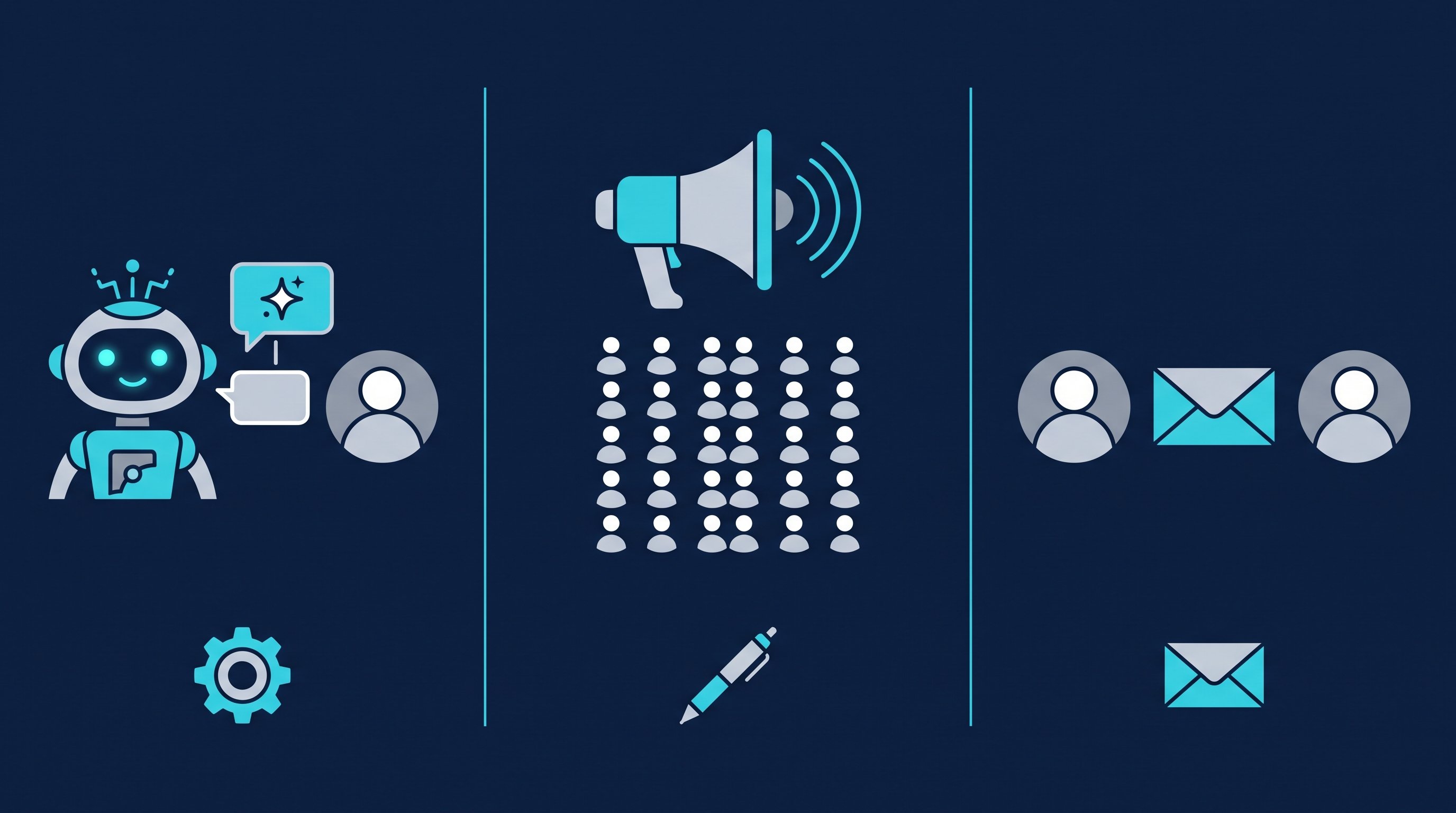
Case 1: the AI system interacts itself | Case 2: published text | Case 3: a message to one person | |
|---|---|---|---|
Example | chatbot on a website, AI agent managing correspondence | post on an economic development, report on a company website | follow-up to a prospect, outreach to a candidate |
Rule | Art. 50(1) | Art. 50(4), second subparagraph | Art. 50(4), second subparagraph requires published text |
Who the text names | providers | deployers | |
Guidelines | para. 30, 31, 36 | para. 131 to 138 | para. 131 i |
Case 1: The AI system talks to people itself
Article 50(1) reads at its core: "Providers shall ensure that AI systems intended to interact directly with natural persons are designed and developed in such a way that the natural persons concerned are informed that they are interacting with an AI system, unless this is obvious from the point of view of a natural person who is reasonably well-informed, observant and circumspect, taking into account the circumstances and the context of use."
The sentence is addressed to the provider who builds the system. The guidelines test four elements: an AI system, intended to interact, directly, with natural persons (para. 30). For sales, the third one matters. Here is para. 30 iii:
"Direct interaction excludes indirect or mediated human interaction where a natural person is exposed to AI outputs without directly interacting with the system (for example, if customer service representatives use AI assistance tools to help them communicate with natural persons or if the AI output is not made available to the person by the AI system itself, but by another person disseminating the content). However, the mere possibility for humans to intervene or review the AI system’s outputs should not be used to circumvent the application of the disclosure requirement under Article 50(1) AI Act. Cases of products and services blending AI-generated responses with human-curated content fall within the scope of Article 50(1) AI Act and require disclosure for the specific outputs in the interaction that are AI-generated, unless those AI outputs have been properly reviewed and sent by humans as the main interlocutors with the natural persons."
In short: for the guidelines, a customer service rep with an AI assistance tool is an example of mediated interaction. The mere possibility to step in is not enough. The last sentence describes the workflow that counts: AI outputs that a human has properly reviewed and sends personally, as the main point of contact for the other person.
Three more passages belong here:
- Para. 30 iii also counts "capabilities of the system to write and send messages to natural persons" as direct interaction.
- According to para. 31, AI agents fall under Article 50(1) when they interact with people while carrying out their tasks, explicitly including "managing correspondence".
- Rule-based automation is not an AI system. Para. 30 i names "traditional out-of-office emails, rule-based quick message answers".
What a notice can look like is shown in para. 36, for example "an email generated by an AI agent sent to a natural person that features an AI label at the top".
Case 2: Published text on matters of public interest
The second subparagraph of Article 50(4) reads: "Deployers of an AI system that generates or manipulates text which is published with the purpose of informing the public on matters of public interest shall disclose that the text has been artificially generated or manipulated." The obligation does not apply "where the AI-generated content has undergone a process of human review or editorial control and where a natural or legal person holds editorial responsibility for the publication of the content".
The guidelines break this down into three elements in para. 131:
- Published: The text is "accessible by an indeterminate, fairly large number of unrelated, potential readers simultaneously and/or successively". A closed, private group does not count.
- Informing the public: The text communicates knowledge, opinions or facts. Para. 131 ii: "short texts which do not materially communicate knowledge, opinions or facts, cannot be deemed to inform the public."
- Public interest: for example politics and democratic processes, public administration, justice, fundamental rights, public security, public health, the environment, consumer safety "and any economic, financial, political, scientific, or cultural development that may be relevant subject of public debate".
As examples inside Article 50(4), the guidelines list among others an AI-generated storm warning on a meteorological institute's social media profile and AI-manipulated corporate reports with investor information from a listed company. Outside it they list, among others, "AI-manipulated text that is part of a company’s advertisement or product descriptions (not including any claims related to e.g. health, consumer safety or sustainability)".
When the exception applies
Both conditions have to be met together (para. 133). What the guidelines mean by them is useful for anyone who publishes AI text:
- A real review: the deliberate examination of the substance by people with relevant knowledge. "Fact-checking the accuracy of the content is a minimum requirement that should be part of that review" (para. 134).
- Spelling is not enough: "Superficial, solely formal or procedural checks (e.g. spell-checking or grammatical correction)" do not meet the condition according to para. 135, and neither do automated checks or cursory sign-off.
- No AI after sign-off: If an AI still changes the text substantially afterwards, this "will therefore cause the exception to become void" (para. 136).
- Someone puts their name to it: Editorial responsibility means "the ultimate legal responsibility over the publication". Name and contact details should be "publicly available on an easily findable location" (para. 138).
Case 3: The message to one person
The second subparagraph of Article 50(4) is tied to published text. For the opposite, the guidelines give examples in para. 131 i:
"Examples of text not considered published include e.g. private, interpersonal correspondence (for professional purposes), or organisation-internal texts or communications (e.g. publications on internal corporate networks)."
So professional correspondence between people appears there as an example of text that is not published, as does a small, closed group on a messaging app.
Case 1 stays separate. The guidelines do not define it by the recipient but by who interacts: the AI system itself, writing and sending messages, or a human who reviews AI outputs and sends them personally (para. 30 iii).
Posts and comments on LinkedIn
A post in the feed can be read by many people, unlike a direct message. Whether it falls under the second subparagraph of Article 50(4) depends, according to the guidelines, on all three elements of para. 131, not on the platform. The examples sort by content: storm warning and investor information on one side, advertising and product descriptions on the other. For short texts without material knowledge, opinions or facts, para. 131 ii applies.
The guidelines do not give a blanket answer for where a single post or comment lands. For your content plan, this means: a post about your product is closer in content to the advertising example, a post on an economic, political or scientific development is closer to the list of topics in para. 131 iii.
Either way, the exception from Case 2 works as a routine for every post with an AI share: review the content, check the facts, publish under your own name, and run no more AI over the text afterwards. How to build reach with comments is covered in Post less, comment more.
What LinkedIn labels itself
LinkedIn shows Content Credentials based on the C2PA standard, for images and videos: "Members can view the Content Credentials on all image and video content that has C2PA information attached." In select countries you can state when uploading that an image or video was created with AI. The page does not describe a label for text posts, comments or messages (LinkedIn Help: Content Credentials).
Images, videos and deep fakes in brief
Article 50(2) requires providers of generative AI to mark their outputs in a machine-readable format, for existing systems by 2 December 2026. The text is addressed to the makers of the generators. The first subparagraph of Article 50(4) requires deployers to disclose deep fakes in images, audio and video. For evidently artistic, satirical or fictional works, a notice that does not hamper the display of the work is enough.
Good practice: the AI drafts, you send
The law is one side, the craft is the other. An AI message that sounds like AI gets no reply. One with a mistake about the recipient's company costs you the contact.
Our recommendation: the AI writes the draft. You read it, change it and send it under your name. Before that, you go through five points:
- Facts: Is every statement about the person, their company, their role and your offer correct?
- Relevance: Does the message mention something that fits only this person, such as one of their posts or a conversation at a trade show?
- Tone: Does the text sound like you? Formal or casual as in your earlier exchange, your length, your words.
- Reason: Why are you writing now? Without that reason, every message feels random.
- One ask: one message, one topic, a simple question at the end.
After your last edit, no AI runs over the text again. Otherwise you are no longer reviewing what goes out. And if someone asks whether you use AI, say so openly.
For the final look there is our free Message Check: it rates length, personal relevance, open question and salesy language, without AI, right in your browser. Which AI tools exist for LinkedIn is covered in LinkedIn AI tools.

Sales, recruiting and job applications
Sales
You spoke to a head of purchasing at a trade show. The AI turns your notes into a draft. You check the date, the product and the numbers, add the line from the conversation she will remember, and send. Your Monday post, on the other hand, can be read by many people. The three elements from Case 2 apply to it.
Recruiting
You reach out to a candidate. The AI summarises her profile and drafts the first message. You check whether the roles and skills it mentions really appear in her profile, and you add why she in particular fits the job. The job ad itself is a public text. How recruiters plan their outreach on LinkedIn is shown in CompLeadly for recruiters.
Job applications
You write to the hiring manager at the company you want to work for. The AI helps with the wording, you supply the content: which role, which experience, why exactly this company. Check every statement about the company before you send. Examples for the connection request that comes first are in our LinkedIn connection message templates.
How CompLeadly uses AI
Two features in CompLeadly work with AI drafts, and with both you see every text in the default settings before it goes out:
- Smart Comment AI is an add-on and requires Sales Navigator. An AI writes comments on posts from your target audience. By default they land in a review list, and you approve each comment. Sending without review is switched off out of the box.
- Smart Chat is an add-on in the Lite and Premium tiers and brings your LinkedIn inbox into CompLeadly. No built-in AI replies there. Your own AI, such as ChatGPT or Claude, writes reply drafts through MCP access. You read, edit and send yourself. How to connect your AI is covered in ChatGPT and Claude for LinkedIn automation.
Plans and add-ons are on the pricing page.
In Germany: who supervises
Germany's AI Market Surveillance and Innovation Promotion Act (KI-MIG) of 22 July 2026 states in Section 2(1): "The Federal Network Agency is the market surveillance authority responsible for compliance with Regulation (EU) 2024/1689, unless otherwise provided in this Act." (our translation). According to its press release of 29 July 2026, the Federal Network Agency (Bundesnetzagentur) "also monitors compliance with the transparency obligations" within its areas of responsibility (our translation).
Sources
- Regulation (EU) 2024/1689, Articles 3, 50, 113, EUR-Lex
- Regulation (EU) 2026/1744 of 8 July 2026 (Digital Omnibus on AI), Official Journal of 24 July 2026, EUR-Lex
- European Commission, Guidelines on the implementation of the transparency obligations for certain AI systems under Article 50 of Regulation (EU) 2024/1689, C(2026) 5054 final, 20 July 2026, AI Act Service Desk (PDF)
- KI-MIG of 22 July 2026, BGBl. 2026 I No. 223 (in German), gesetze-im-internet.de
- Bundesnetzagentur, press release of 29 July 2026 (in German), bundesnetzagentur.de
- LinkedIn Help, Content Credentials, linkedin.com
All accessed on 7 October 2026.
FAQ: AI disclosure under Article 50
What does EU AI Act Article 50 require?
Article 50 sets the transparency obligations of the EU AI Act. Providers of AI systems that interact directly with people make sure those people are informed, and providers of generative AI mark outputs in a machine-readable format. Deployers disclose deep fakes and AI text published to inform the public on matters of public interest.
Since when does AI disclosure under Article 50 apply?
Since 2 August 2026. Only for the machine-readable marking under paragraph 2 does the Digital Omnibus give providers of existing systems until 2 December 2026.
Does AI-generated text need to be labelled?
The second subparagraph of Article 50(4) names AI text published to inform the public on matters of public interest. The obligation does not apply if a human has reviewed the text and a person holds editorial responsibility. According to the Commission guidelines, a spelling or grammar check alone does not count as a review.
What do the guidelines say about professional messages to individuals?
The guidelines of 20 July 2026 name "private, interpersonal correspondence (for professional purposes)" as an example of text not considered published (para. 131). AI systems that write and send messages themselves are treated separately under Article 50(1) (para. 30).
Did the Digital Omnibus postpone AI disclosure?
Only the machine-readable marking under paragraph 2 for systems that were on the market before 2 August 2026. Paragraphs 1, 4 and 5 have applied unchanged since 2 August 2026.
Does LinkedIn label AI content?
LinkedIn shows Content Credentials based on the C2PA standard for images and videos. In select countries you can state when uploading that an image or video was created with AI. The help page does not describe a label for text posts, comments or messages.