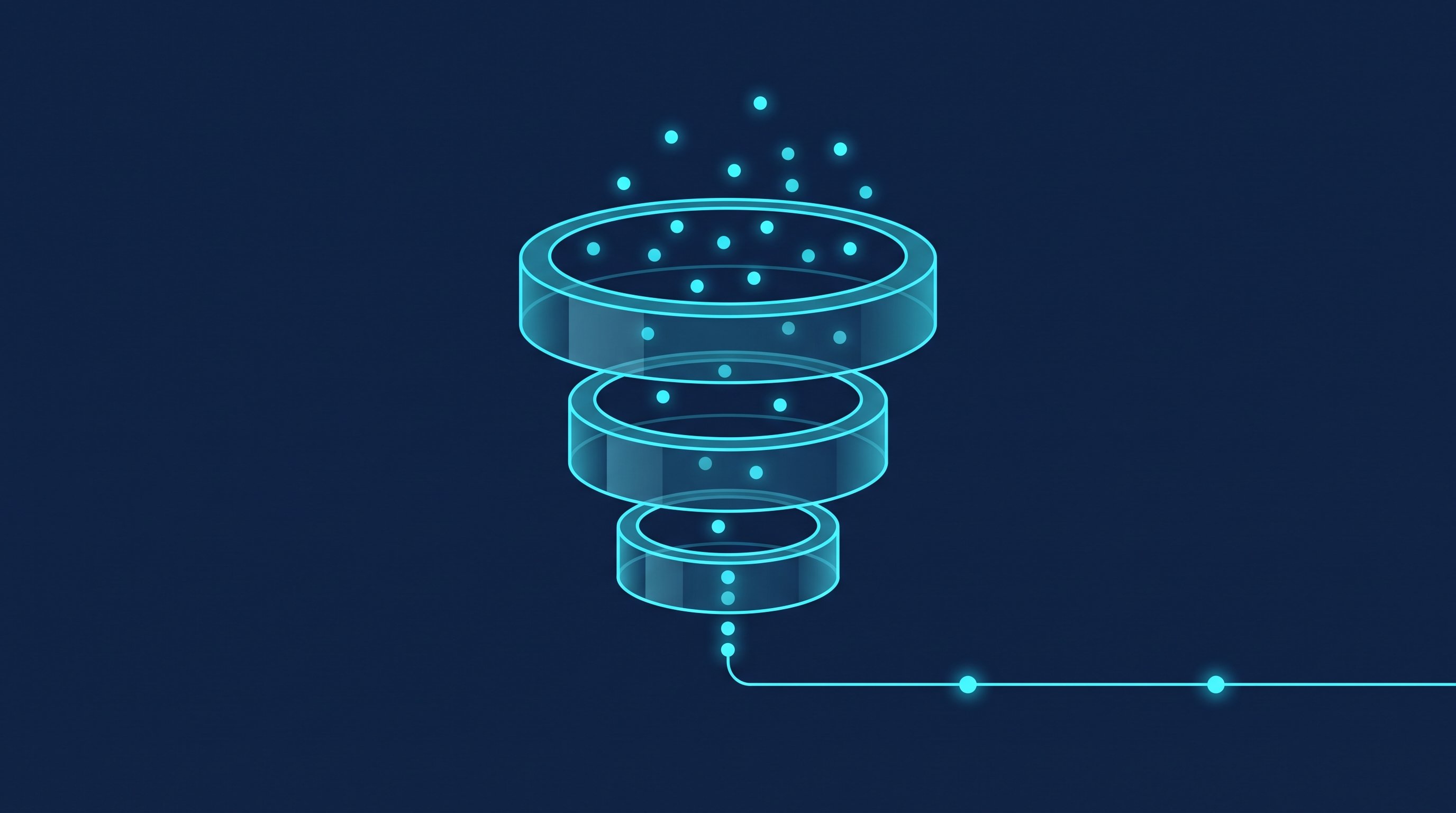
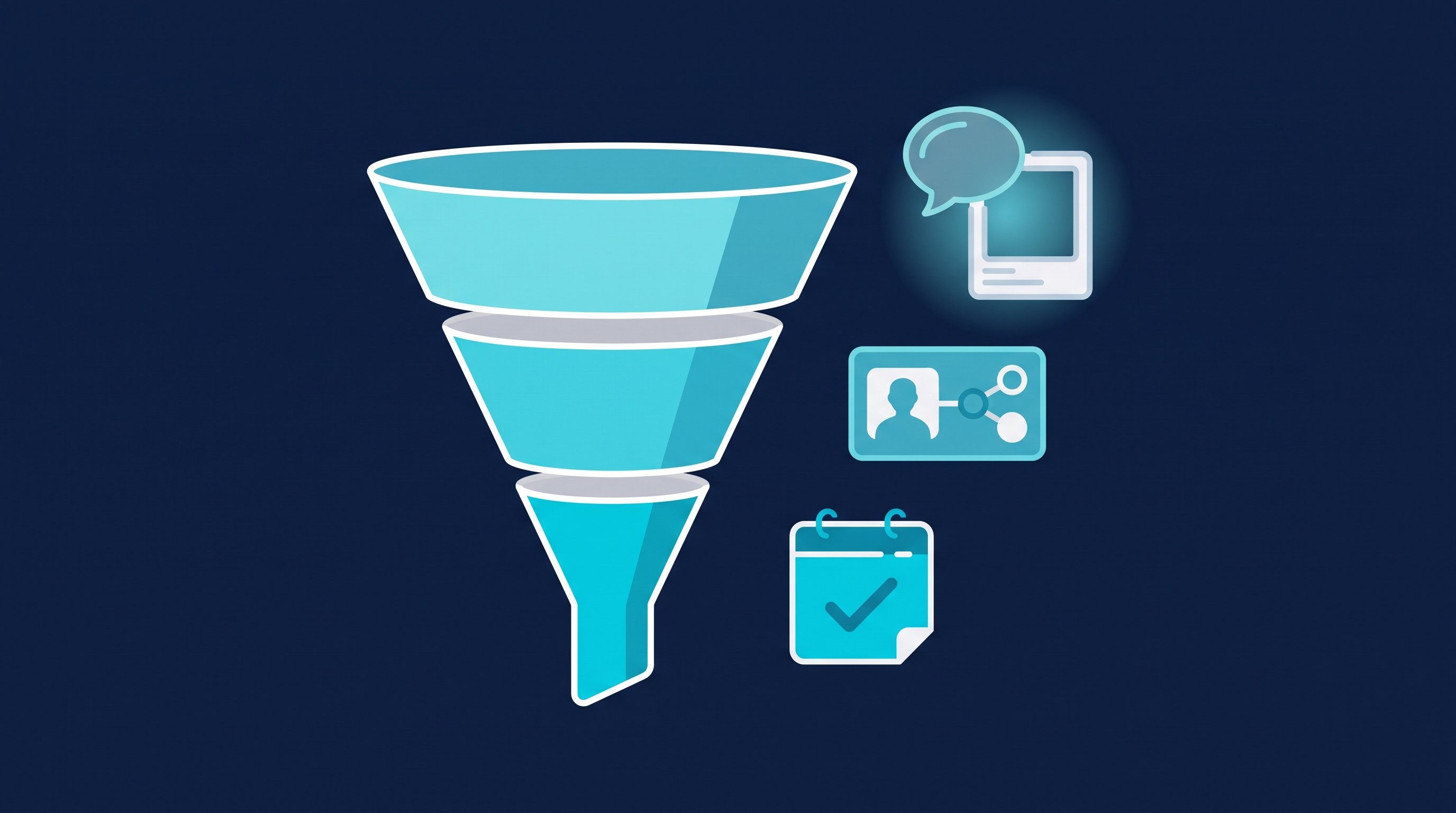
In short: A marketing funnel splits the path from first contact to purchase into three stages: awareness (TOFU), interest and evaluation (MOFU), decision (BOFU). At each stage you measure how many people move on to the next one. On LinkedIn that means posts and comments at the top, profile and connecting in the middle, conversation and meeting at the bottom.
As of: October 2026.
Most funnel graphics look good and do nothing. They show a funnel in three colours, but no number you can change on Monday. This post sticks to what you need: clear terms, one formula per stage and a worked example that takes your meeting target and tells you how many people you have to reach at the top.
What is a marketing funnel?
A marketing funnel describes how many people who see you for the first time turn into a few customers. It is wide at the top and narrow at the bottom, because some people drop out at every stage. That is not a flaw. It is normal.
In B2B, three stages have become the standard:
Stage | Short form | What the buyer thinks | What you deliver |
|---|---|---|---|
Top of Funnel | TOFU | "I have a problem, or I suspect I do." | Posts, articles, comments that name the problem |
Middle of Funnel | MOFU | "How do others solve this, and who can help?" | Profile, comparisons, templates, a first conversation in chat |
Bottom of Funnel | BOFU | "Does this offer fit, and at what price?" | Meeting, demo, proposal |
Some models split it more finely, for example by AIDA (Attention, Interest, Desire, Action). For steering, three stages are enough, as long as each one has a criterion you can check. More stages only make sense if you also collect a separate number for each.
Marketing funnel, sales funnel and pipeline: the difference
The three terms are often used as if they meant the same thing. They describe different sections, though, and answer different questions.
Term | Section | Question | Unit |
|---|---|---|---|
Marketing funnel | From first contact to the lead that marketing hands over to sales | How many readers become leads? | People, over a period |
Sales funnel | From the handed-over lead to the closed deal | How many leads become customers? | Leads, over a period |
Sales pipeline | All open sales opportunities as of today | Which deal is where, and what is the next step? | Individual deals, today |
The seam between marketing and sales is usually called MQL and SQL. An MQL (Marketing Qualified Lead) meets marketing's criteria. An SQL (Sales Qualified Lead) has been checked by sales and is being actively pursued. What exactly sits behind the terms is explained in What is a lead?. Write down the criteria for both, or every team will count differently.
In a small B2B team without separate departments, the line blurs. You are marketing and sales in one person, and the funnel runs from post to contract without a handover. The stages are still useful, because they show where you lose people. For everything from the meeting onwards you use a pipeline. Stages, template and upkeep are covered in Sales pipeline template.
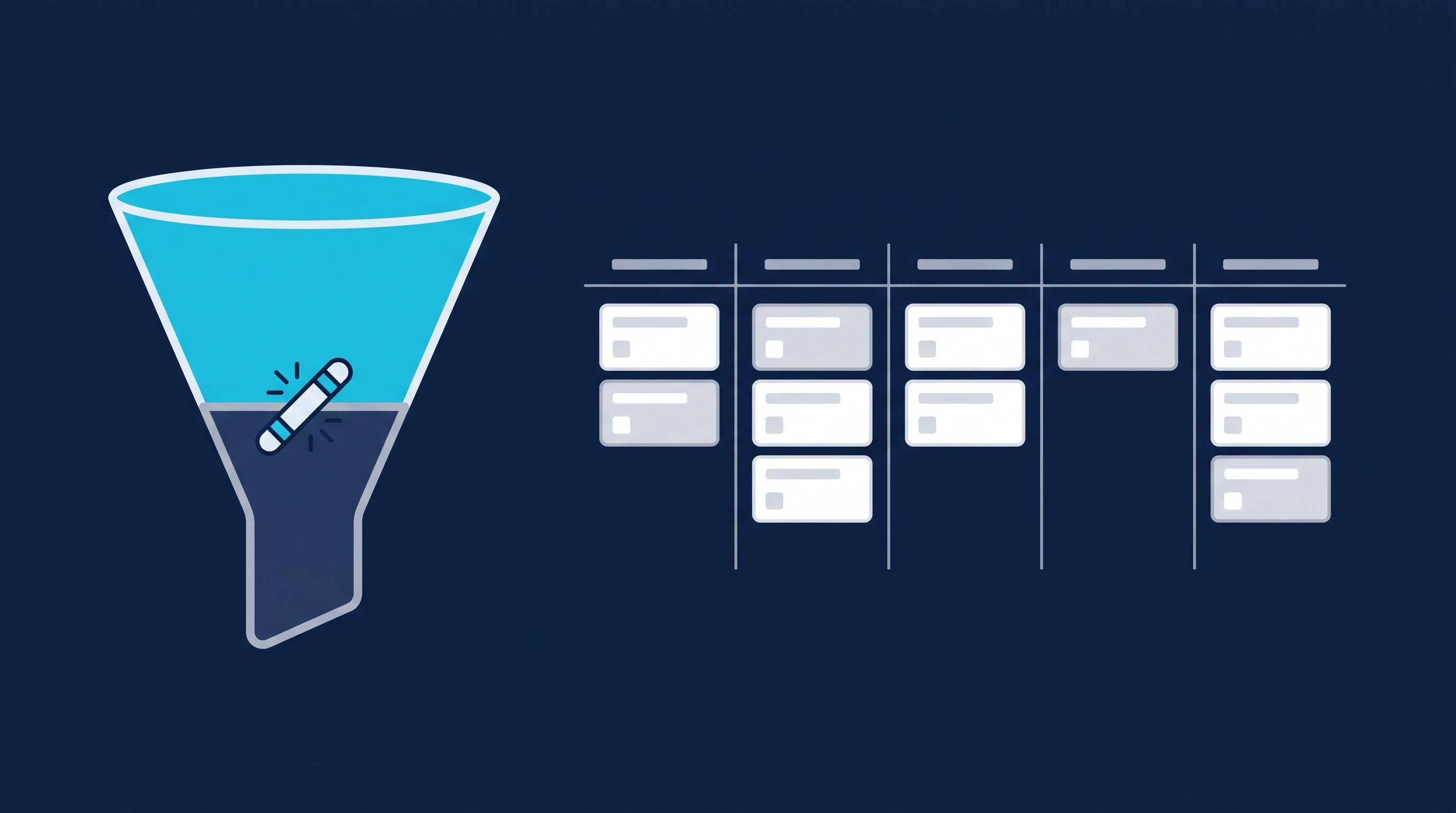
The B2B stages and their metrics
Every stage needs a metric that shows whether it does its job. The following table sets this out for a B2B funnel with LinkedIn as the main channel.
Stage | Goal | Metric | Formula |
|---|---|---|---|
TOFU | The right people see you | Reach within the target audience | Number of people reached who match your ideal customer profile |
TOFU to MOFU | Readers become contacts | Acceptance rate | accepted connection requests ÷ requests sent × 100 |
MOFU | Contacts become conversations | Reply rate | contacts who replied ÷ contacts messaged × 100 |
MOFU to BOFU | Conversations become qualified leads | Qualification rate | qualified leads ÷ conversations held × 100 |
BOFU | Leads become meetings | Meeting rate | meetings booked ÷ qualified leads × 100 |
overall | What a lead costs you | Cost per lead | channel costs ÷ leads won |
All transitions follow the same basic formula:
Conversion rate (stage A to stage B) = number who reached B ÷ number who reached A × 100
Always calculate it for a cohort. Take all contacts who started stage A in the same period and see how many of them reached B. If you divide the count at the end of the month by the requests sent in that same month, you mix people from different weeks and get a number that means nothing.
How to calculate cost per lead properly and what belongs in the costs is covered in Cost per lead.
Benchmarks: why we don't give any
Percentages for "good" conversion rates per stage circulate online. For the ones we found, the source, the date or the method is missing. An acceptance rate depends on the target audience, the profile and the note. A reply rate depends on the first message. So compare your numbers with yourself: audience against audience, text against text, month against month.
Worked example: calculating backwards from your meeting target
The following rates are made up and only serve to show the calculation. Plug in your own.
Say you want 4 meetings a month:
Step | Example rate | Calculation | Result |
|---|---|---|---|
Meetings (target) | 4 | ||
Qualified leads | Meeting rate 50 % | 4 ÷ 0.5 | 8 |
Conversations | Qualification rate 40 % | 8 ÷ 0.4 | 20 |
Contacts messaged | Reply rate 20 % | 20 ÷ 0.2 | 100 |
Connection requests sent | Acceptance rate 35 % | 100 ÷ 0.35 | about 286 |
About 286 requests a month is roughly 14 a day across 20 working days. Now you can see the levers. If the reply rate rises from 20 to 25 percent, you only need 80 contacts messaged and about 229 requests. A better first message saves you about 57 requests a month. That is usually easier than messaging more people.
For this calculation there is our free campaign calculator. You enter contacts per week and your rates and see acceptances, replies and meetings for one month.
Why the top of the funnel is wider than you think
The funnel invites a thinking error: whoever falls in at the top will soon slide out at the bottom. In B2B that is rarely true. Most people who read your post are not buying anything right now, because they have already solved the problem or it is not pressing yet.
LinkedIn calls this the 95-5 rule: "95% of your potential buyers aren’t ready to buy today", but they will be "in-market" sometime in the future. As evidence, LinkedIn cites its joint research with the Ehrenberg-Bass Institute, according to which "75% of companies buy computers once every 4 years, 80% of companies change banking services once every 5 years". LinkedIn recommends "flipping the funnel on its side" and puts it this way: "Invest in lead-generation efforts targeting the 5% of people who are “in-market” today, but don’t forget to invest far more heavily in reaching the entire category" (LinkedIn Marketing Blog, 18 May 2022).
For your funnel this means two things. First: don't measure TOFU only by how many leads drop out this week. A post a head of purchasing reads today may pay off in a year. Second: someone who doesn't buy today is not a lost contact. Keep the connection instead of giving up after two messages.
The role of LinkedIn at every stage
LinkedIn covers all three stages, in the same interface and with the same people. That is what makes the channel so practical for B2B funnels.
TOFU: posts and comments
At the top, what counts is whether your target audience notices you. Your own posts build this slowly. Comments under posts from the people you want to reach work faster: you show up where your audience is already reading, and your name appears next to a topic they care about. How to do this in practice is shown in Post less, comment more. Why visibility and trust go together is covered in Why LinkedIn content is your best salesperson.
MOFU: profile, connecting and the first conversation
In the middle, people look at your profile before they accept a request or reply to you. Your profile is your landing page here. A headline that says who you help achieve what does more than a job title. Then comes the connection request, with or without a note. Which fits better when is covered in LinkedIn connections: with or without a message. The first message after acceptance is the moment a contact becomes a conversation. Don't sell anything yet. Ask a question.
BOFU: the meeting
At the bottom, the job is to get from chat to a real conversation. Many people lose here, because they ask for the meeting too early or too late. How to make that step is shown in Why many LinkedIn meetings fall through. From the meeting onwards, your pipeline takes over.
If you want to read the whole approach, listening, commenting, connecting and holding conversations, as one method: that is social selling.
Finding the bottleneck: how to read your numbers
A funnel almost always has exactly one stage that loses more people than the others. That is where you start, and only there. The table helps you read it.
What you see | What it usually means | Where to start |
|---|---|---|
Many requests, few acceptances | Audience or profile don't match the request | Narrow the audience, sharpen the profile headline, test the note |
Many acceptances, few replies | The first message triggers nothing | Write shorter, name a personal reason, end with a question |
Many replies, few qualified conversations | The list is too broad | Sharpen the ideal customer profile, set exclusion criteria |
Many qualified leads, few meetings | The step to the meeting is missing or comes too late | Propose a concrete meeting with two time slots |
Change only one thing at a time and measure for two to four weeks. Otherwise you won't know what worked. Which other prospecting metrics are worth watching is covered in What is prospecting?.
The funnel in sales, in recruiting and in job hunting
Sales
You sell software to logistics companies. TOFU is your comments under posts from dispatchers and managing directors, MOFU the connection and a question about their route planning, BOFU the meeting for a demo. The metrics from the table above apply unchanged. How teams set this up together is shown in CompLeadly for sales teams.
Recruiting
The candidate funnel has the same shape. At the top sits your visibility as an employer, for example through posts from the team. In the middle come the connection and a first message to suitable candidates, at the bottom the interview. Instead of a meeting rate, you measure the interview rate: interviews ÷ candidates in conversation × 100. Wording for every stage is in LinkedIn recruiting messages, the whole process on the page for recruiters.
Job hunting
As a job seeker you run a funnel too, just in the other direction. At the top are the employers you want to work for and the right people there: recruiters, hiring managers, future colleagues. In the middle you connect and ask a concrete question about the role or the team. At the bottom is the interview. Calculate backwards here as well: with your rates, how many requests do you need for two interviews a month? Which mistakes to avoid along the way is covered in 10 common LinkedIn mistakes when job hunting.
How CompLeadly helps in the funnel
On LinkedIn, CompLeadly takes over the recurring steps in the middle of the funnel and gives you the numbers for them. The content at the top and the conversation at the bottom stay with you.
- Target audience from your search: You build the target audience from a LinkedIn people search, a Sales Navigator search or, with Recruiter access, a Recruiter search.
- Workflows for the middle: Profile visit, connection request with or without a note, opener after acceptance and follow-ups run one after another, with daily limits you set yourself. A follow-up only goes out once the previous message has gone unanswered for as many days as you set. If the contact has replied, no further follow-up goes out.
- Smart Chat: The add-on (Lite or Premium) brings your LinkedIn inbox into CompLeadly. Every reply there is a conversation in your MOFU stage.
- Smart Comment AI: The Smart Chat Premium add-on uses AI to write comments under posts from your target audience, so at the top of the funnel. It requires Sales Navigator. By default every comment first lands in a review list, and you approve it.
- Statistics: You see connections, acceptances and replies week by week. Those are the values for your acceptance rate and reply rate.
After the 10-day trial with all features, you can keep using CompLeadly for free, then with basic features and a daily limit, for example 2 connection requests, 1 opener and 1 follow-up per day, each step started individually. Full workflows start with Basic. All plans and add-ons are on the pricing page.
FAQ: B2B marketing funnel
What is a marketing funnel, in simple terms?
A marketing funnel shows how many people who see you for the first time turn into a few customers. It usually has three stages: awareness (TOFU), interest (MOFU) and decision (BOFU). At every stage some people drop out.
What do TOFU, MOFU and BOFU mean?
Top, middle and bottom of funnel. TOFU is the first moment someone notices you, for example through a post. MOFU is the phase in which someone checks who can help. BOFU is the decision, in B2B usually a meeting or a proposal.
What is the difference between a marketing funnel and a sales funnel?
The marketing funnel runs from first contact to the lead that marketing hands over to sales. The sales funnel starts there and ends with the closed deal. The sales pipeline, on the other hand, shows all open deals as of today with their next step.
How do I calculate the conversion rate in a funnel?
Divide the number who reached the next stage by the number at the previous stage and multiply the result by 100. Always calculate it for a cohort, meaning all contacts who started in the same period.
What is a good conversion rate in B2B?
We have not found general values with a reliable source. The rates depend on audience, offer and channel. Compare your numbers with your own previous month and change only one thing at a time.
What role does LinkedIn play in a B2B sales funnel?
LinkedIn covers all three stages: posts and comments create awareness, profile and connecting carry the middle, messages lead to the meeting. You reach the same people at every stage.