In short: A letter of interest is an application to a company that has no matching job posted right now. It consists of a cover letter and resume, goes to a specific person, and names the area and your name in the subject line. A direct route also runs through LinkedIn: find the right person, connect, write briefly, follow up once.
As of November 2026. LinkedIn limits and CompLeadly prices refer to this month.
A letter of interest has one drawback and one advantage. The drawback: nobody is waiting for it. The advantage: you're not competing with everyone who answers the same posting. For the advantage to count, your application has to reach a person who has a problem you can solve. In a generic careers inbox, it easily gets lost.
This post covers the classic structure with a template to copy, then the direct route through LinkedIn with message templates. What to avoid on LinkedIn during a job search in general is covered in common LinkedIn mistakes when job hunting. Here, the focus is the application itself.
When a letter of interest makes sense
A letter of interest makes sense when you want a specific company, not just any job. Typical cases are a dream employer with no matching posting, smaller companies without their own HR team, and a move into a new industry where no job board will find you.
Good timing shows in movement at the company: a new location, a funding round, a new team lead or several postings in neighboring areas. A company that's growing may need people before anyone writes the job ad. With a letter of interest, you're already there.
It makes less sense at large corporations that route every application through a portal and explicitly rule out unsolicited applications there. Check the careers page before you write.
How to structure a letter of interest
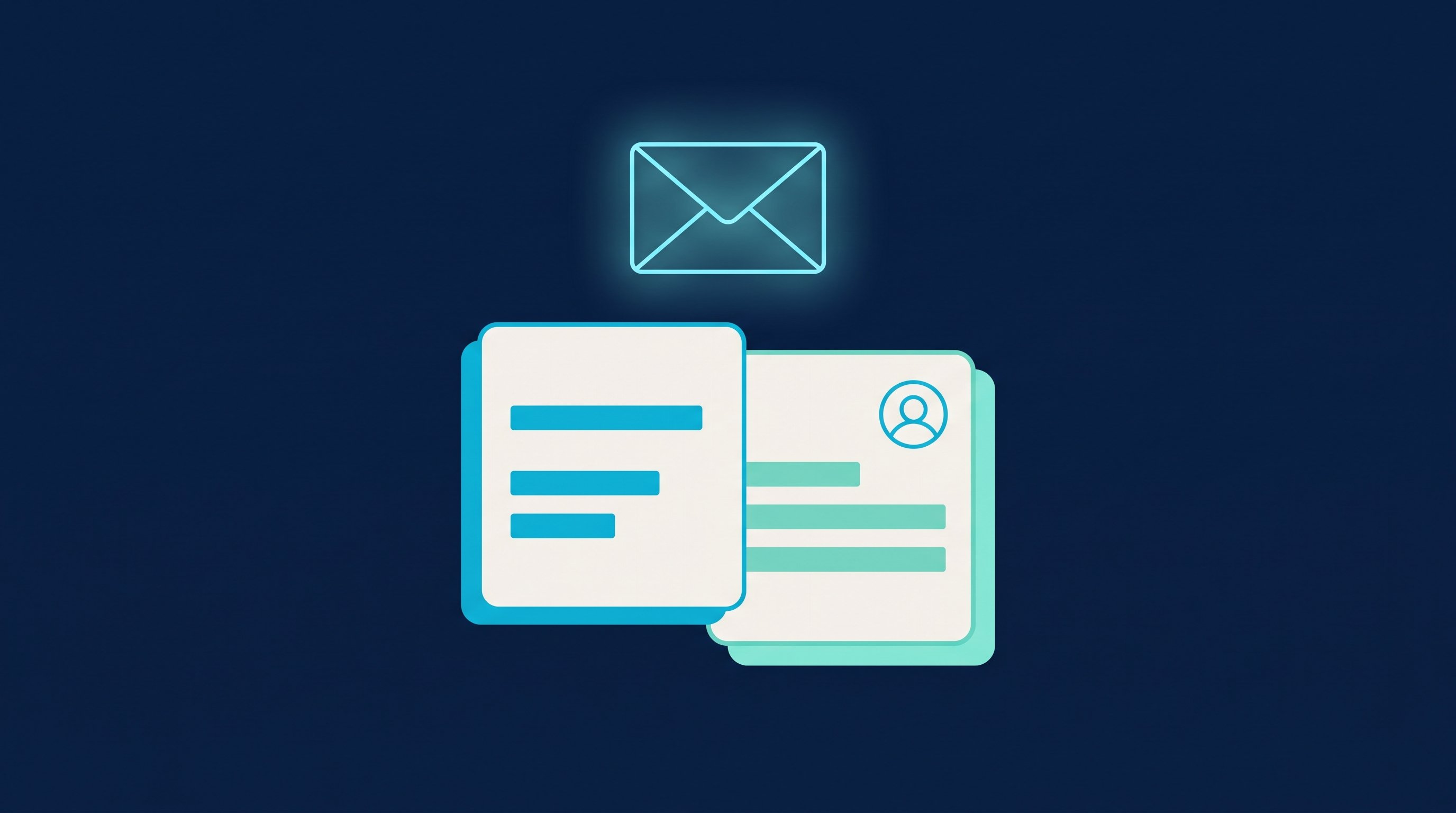
The documents are the same as for any application. The difference is the cover letter: it has to explain why you're reaching out without a posting and which role you want to take on.
Subject line
The subject line names the area and your name so the email reaches the right team. Examples:
- Letter of interest: Sales Director, Northeast, Maria Example
- Letter of interest, finance and controlling, available from March: Tom Sample
- Letter of interest, customer success: Ali Example
More subject line patterns are in cold email subject lines.
Cover letter
The cover letter fits on one page and follows this structure:
- Greeting with a name: Never "To Whom It May Concern" if you can find the name. The section on finding the right contact below shows how.
- Opening with a reason: Why this company? Name something concrete, like a product, a new location or a post by the team lead.
- What you bring: Two results from your work so far, ideally with numbers that match the job.
- What you're looking for: Area, role, possible start date. A letter of interest without a clear goal lands with no team.
- Close with a next step: Suggest a short call instead of hoping for a reply.
Resume and attachments
Your resume lists your current role first. Whatever fits the role you want gets more space than everything else. One to two pages are enough in most cases. Send everything as one PDF file. References can be listed or offered on request. How to show your resume on LinkedIn as well is explained in how to add your resume to LinkedIn.
Letter of interest template to copy
Replace everything in square brackets and cut what doesn't fit.
Subject: Letter of interest: [role] in [area], [your name]
Dear Ms. [Last name],
[Company] is currently expanding [specific trigger, for example: its Chicago office / its business with industrial customers]. That's exactly the field I've worked in for [number] years, most recently as [role] at [current company]. That's why I'm reaching out about a [role] position on your team.
In my current role, I [result 1 with a number, for example: cut response time for customer requests from five days to two]. I also [result 2 with a number]. Both carry over directly to [task at the target company].
I'm looking for a role where I can take on [specific contribution]. I can start on [date]. My resume is attached.
I'd welcome a short conversation, by phone if that's easier, in the next two weeks.
Best regards,
[Your name]
[Phone, LinkedIn profile]
If you send your application by email, attach the cover letter as a PDF and keep the email itself to three sentences: who you are, what you're looking for, what's attached. For greetings and sign-offs, see email greetings and how to end an email.
Email text for your letter of interest:
"Dear Ms. [Last name], I'm a [role] with [number] years of experience in [area], and I'm reaching out to [company] because [one specific reason]. My cover letter and resume are attached. I'd be glad to talk briefly in the coming weeks. Best regards, [your name]"
Checklist before you hit send
- The contact's name is spelled correctly and their title is checked.
- One specific reason for this company in the first paragraph.
- Role or area clearly named, not "something in marketing".
- Two results from your work, ideally with numbers.
- Start date and phone number included.
- Everything in one PDF, with your name in the file name.
- Your LinkedIn profile tells the same story as your cover letter, in case someone looks.
Finding the right contact
The best address is the person who leads the team you want to join. That's where people know which work is piling up. Next comes recruiting, and at small companies the leadership team. Here's how to find them:
- Company website: team page, careers page and the legal notice or about page, which often names the leadership.
- LinkedIn people search: filter for the company and add terms like "head of", "director" or "team lead" plus the area.
- The same company's job postings: postings in other areas help too. On a job's details page, LinkedIn can show a "Meet the Hiring Team" section, and according to LinkedIn Help you can connect with and message that team.
- "Actively hiring" filter: in people search, it shows people who are hiring for specific roles. LinkedIn lists it as a Premium feature.
- Google: an X-ray search finds profiles that LinkedIn search doesn't show you. The how-to is in LinkedIn X-ray search, and the Boolean search generator builds the query for you.
- Mutual connections and alumni: a referral is the warmest way in. How to find one is shown in LinkedIn mutual connections and the LinkedIn alumni tool.
If you need an email address, see how to find an email address.

The direct route through LinkedIn
On LinkedIn, you reach the person before your documents arrive. The order matters: your first message doesn't ask for a job. Instead, it shows interest in the team and asks a question. The application follows once the other person is open to it.
- Get your profile ready: Your headline and About section say what you do and what you're looking for. Help is in the perfect LinkedIn profile in 6 steps, LinkedIn headline examples and the headline generator. Whether to turn on "Open to work" is covered in Open to work on LinkedIn.
- Signal interest in the company: Some company pages have an "I'm interested" button. According to LinkedIn Help, you can use it for up to 50 companies, your interest expires after a year, and recruiters at that company see you when they search for interested candidates. It isn't shared publicly.
- Connect: With a short note or without one. According to LinkedIn Help, without Premium you can add a personalized note of up to 200 characters to up to three connection requests per month. When a note pays off is covered in connecting with or without a message.
- First message after they accept: Short, with one question about the team.
- Follow up once: If there's no reply after about a week, send one friendly reminder.
- Send your documents: Only once the other person shows interest, or ask who they should go to.
If you're not connected and you have LinkedIn Premium, an InMail is the alternative. How it works is explained in what is LinkedIn InMail.

LinkedIn templates for your letter of interest
Check the length of your notes with the LinkedIn character counter.
Connection note to the team lead:
"Hi [Name], I've been following how [company] is building out [area]. I work in [area] myself and would be glad to connect."
Connection note to a recruiter:
"Hi [Name], [company] is on my short list of employers I'd love to work for. I'm a [role] with experience in [topic] and would be glad to connect."
First message after they accept:
"Thanks for connecting, [Name]. I'm a [role] and most recently [one result in one sentence]. I'm curious how your team is approaching [topic] right now. Would you have 15 minutes for a quick chat in the next few weeks?"
Follow-up after about a week:
"Hi [Name], just following up briefly. If a call doesn't fit right now: who at [company] would be the right person for a letter of interest in [area]?"
Through a mutual connection:
"Hi [Name], [contact's name] suggested I reach out to you. I'm interested in a role in [area] at [company] and would be glad to connect."
If they reply that nothing is open right now, thank them and ask whether you may check back in a few months. More wording for notes is in LinkedIn connection message templates, and for follow-ups in follow-up templates.
Running your LinkedIn outreach with CompLeadly
With ten or twenty target companies, it's easy to lose track of who already has a request and who needs a reminder. CompLeadly handles these steps through your own LinkedIn account. The table shows what you get on which plan.
Step | CompLeadly feature | Plan |
|---|---|---|
Collect contacts | Save a LinkedIn people search with company and title as a target audience | All plans, up to 2 saved audiences on Free |
Find people who are hiring | Audience builder with the filters "Currently hiring" and "Is hiring for this position" | Basic and up |
Connect | Connection request with an optional personal note | Free: 2 per day as a single step; as a workflow from Basic |
First message | Opener: a message to new connections who accepted your request | Free: 1 per day; in a workflow from Basic |
Follow up | Follow-up only after the set number of days without a reply, and no further message once they reply | Free: 1 per day; in a workflow from Basic |
Addresses for your written application | Export jobs with imprint: jobs from a LinkedIn job search as a spreadsheet, including address and contact details from the company's legal notice | Premium and up |
Leave out your current employer | Put profiles on the blocklist, for example your current coworkers | Premium and up |
For a job search with a handful of target companies, the free plan is often enough. With 2 connection requests per day, five workdays give you 10 requests per week. On Free, you start each step yourself. If you want the request, first message and reminder to run as a scheduled sequence, you need Basic at $29.99 per month, or $24.99 on the yearly plan. The export with imprint data and the blocklist come with Premium at $59.99 per month, or $49.99 on the yearly plan. All prices exclude VAT. Details are on the pricing page.
The recruiting perspective
A letter of interest has an easier time when the person reading it can forward it without asking questions. That takes a clear role or area, a cover letter that can be read in a minute, a start date and a phone number. Whoever is looking for "something in marketing" lands with nobody.
Recruiters often walk the same path in the other direction. In active sourcing, they reach out to candidates who haven't applied. People who clicked "I'm interested" on the company page show up in the search for interested candidates, according to LinkedIn Help, which makes a good starting point. In CompLeadly, with your own Recruiter Lite license, a Recruiter Lite search, a pipeline or a saved Recruiter audience becomes a target audience. Connecting, first messages and follow-ups run as a workflow from Basic. For the wording, see active sourcing on LinkedIn and LinkedIn recruiting message templates. The workflow is described on the page for recruiters and in the knowledge base article recruiting with LinkedIn and CompLeadly.

In sales, it works like cold outreach
If you work in sales, you know the mechanics. A letter of interest works like cold outreach, except you are the offer. You find the person with the problem, name a trigger, keep it short and follow up once. Connecting, first message and follow-up work the same way in CompLeadly for sales, just with an audience of decision-makers instead of hiring managers, as a scheduled workflow from Basic. What that looks like in sales is shown in LinkedIn prospecting, cold email and the page for sales teams.
If you want your LinkedIn outreach for a letter of interest to run on a schedule with reminders, try CompLeadly for ten days with the Premium features, no payment details needed. After that, the app keeps running on the free plan with daily limits. You can get the app on the download page.
FAQ: Letter of interest
What is a letter of interest?
An application to a company that has no matching job posted right now. You reach out on your own initiative because you want to work at that specific company, and you suggest a role or an area.
How do I structure a letter of interest?
Like any application, with a cover letter and a resume. The cover letter explains why you're reaching out to this company, names two results from your work, the role you want and your possible start date, and suggests a conversation.
Who should I send a letter of interest to?
Ideally to the person who leads the team you want to join. Next comes recruiting, and at small companies the leadership team. You'll find names on the company website and through LinkedIn people search.
Can I send a letter of interest through LinkedIn?
Yes. Connect with the team lead or a recruiter, send a short message with a question about the team once they accept, and send your documents as soon as they're open to it. You can also click "I'm interested" on the company page where the button is available.
What should the subject line of a letter of interest say?
The words letter of interest, the role or area and your name, for example "Letter of interest: Financial Analyst, Maria Example". That way the email reaches the right team.
When should I follow up on a letter of interest?
Once, after about a week without a reply, friendly and short. Ask at the same time who the right contact would be, in case you landed in the wrong place.