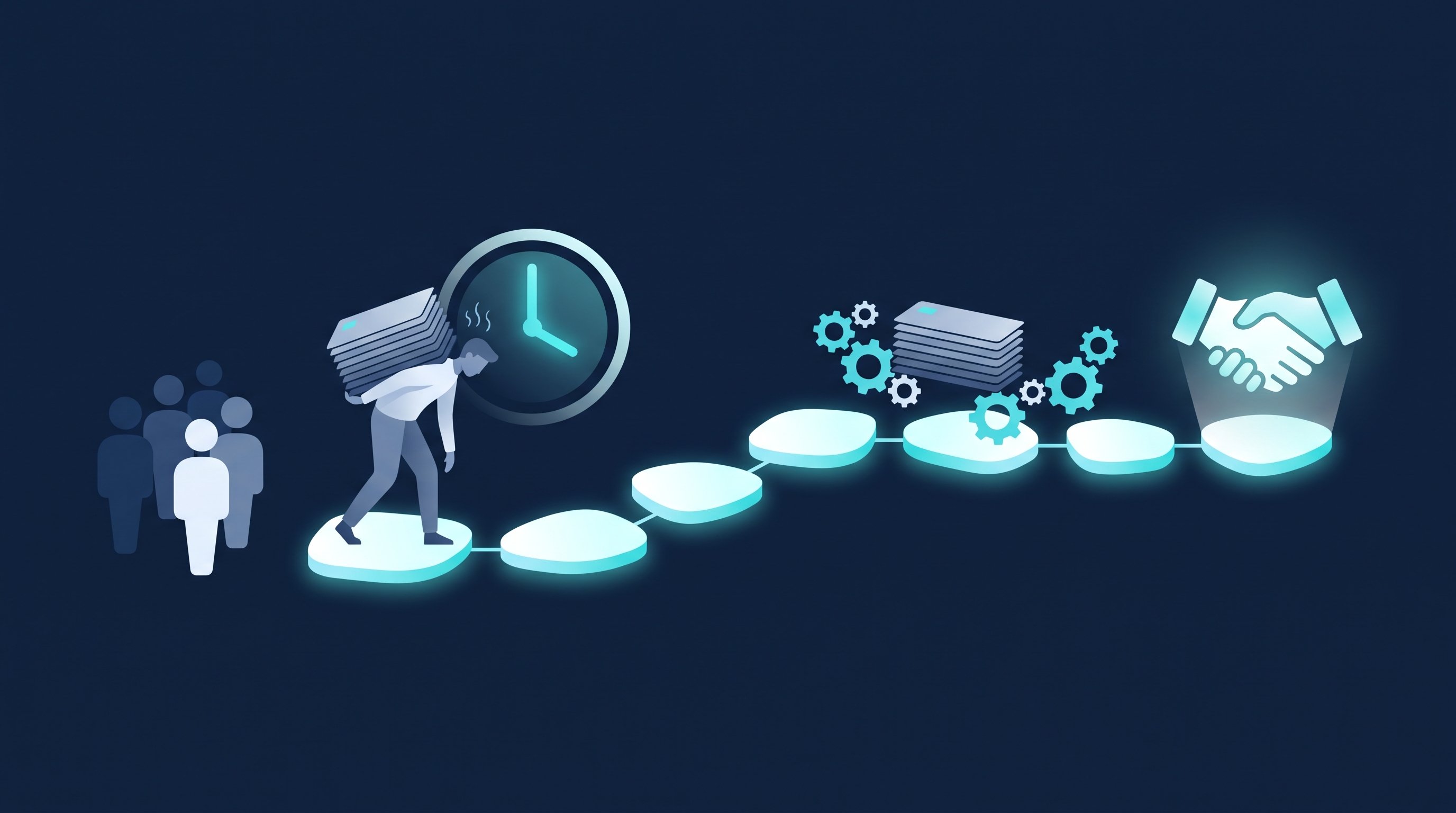
In short: A discovery call is a short meeting that clarifies two things: does the other person have a problem you can solve? And are you a good fit? It is not a pitch and not free consulting. You book it after a reply in the chat with two concrete time slots, prepare for ten minutes and run it in five phases up to a clear next step.
As of: October 2026.
If you sell on LinkedIn, you don't measure success in connections, you measure it in conversations. Coaches call it a free discovery call or free initial consultation, financial advisors an introductory meeting, SaaS teams a discovery call. It always means the same moment: a contact becomes a person you talk to. This post shows the whole path, from the chat to the message after the call, with questions for three audiences. The question method in detail is explained in SPIN Selling, ready-made texts for the request are in the meeting request templates.
What a discovery call is (and what it isn't)
The discovery call has a single goal: to find out whether a second step is worth it. For both sides. At the end there is either a concrete next meeting or an honest no. Both are a good result.
A discovery call is | A discovery call is not |
|---|---|
a way to clarify the situation and the need | a product presentation |
a test of whether you are a good fit | consulting that solves the problem right away |
a conversation in which the other person talks more than you | a questionnaire you work through |
the path to a clear next step | a closing meeting |
Free doesn't mean consulting. Coaches and consultants almost always offer the discovery call for free. That lowers the barrier, but it invites a mistake: if you deliver the solution in the free call, you make your paid offer redundant. So say up front what's included: "We'll look at where you stand and whether I can help you." That is honest and clear.
Discovery call before the demo. In SaaS sales, the discovery call comes before the demo. If you demo without a discovery call, you show every feature instead of the three that matter to the customer. Founders who sell themselves save long demos for people who never buy.
Booking a discovery call: from the LinkedIn message to the meeting
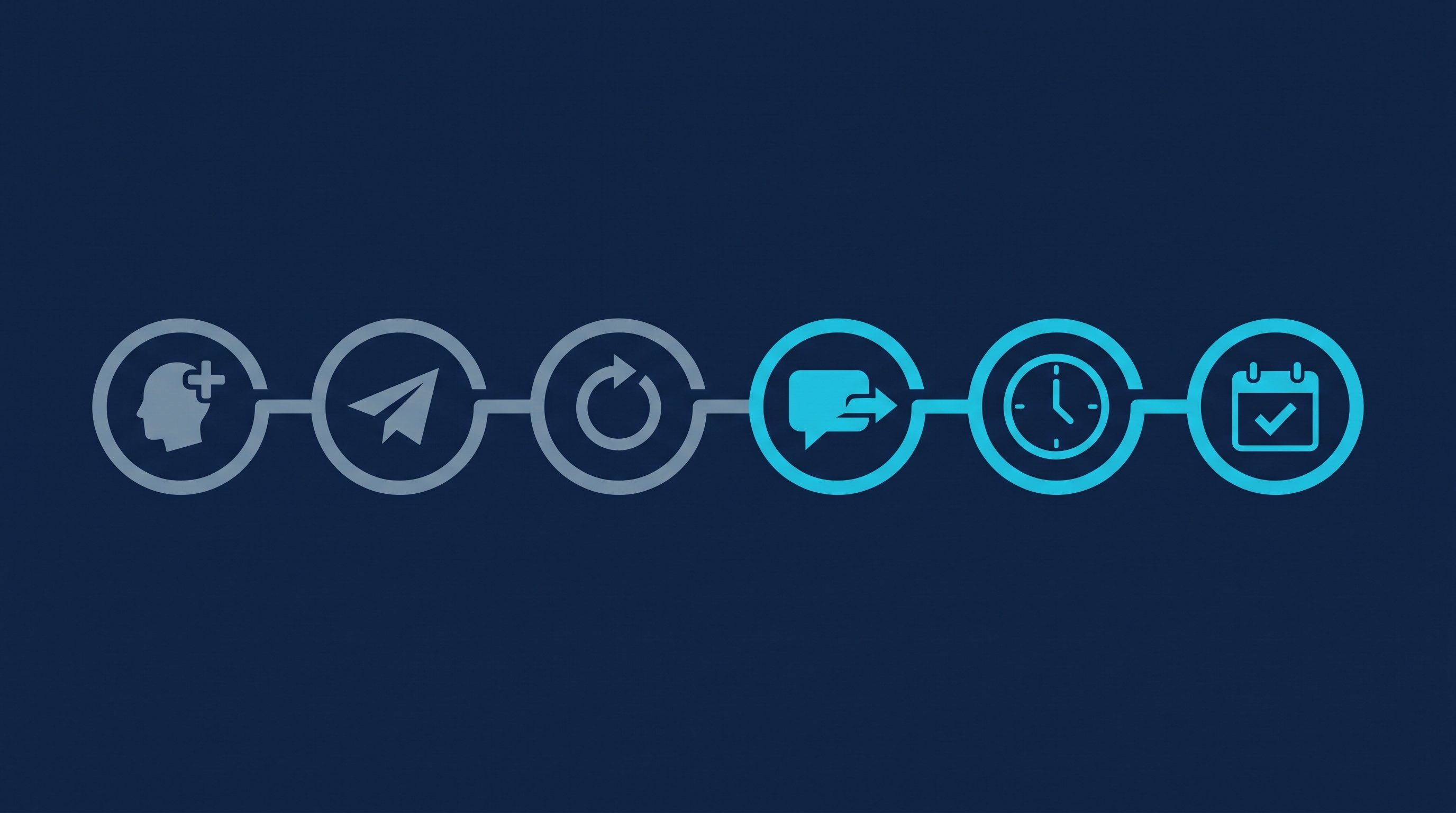
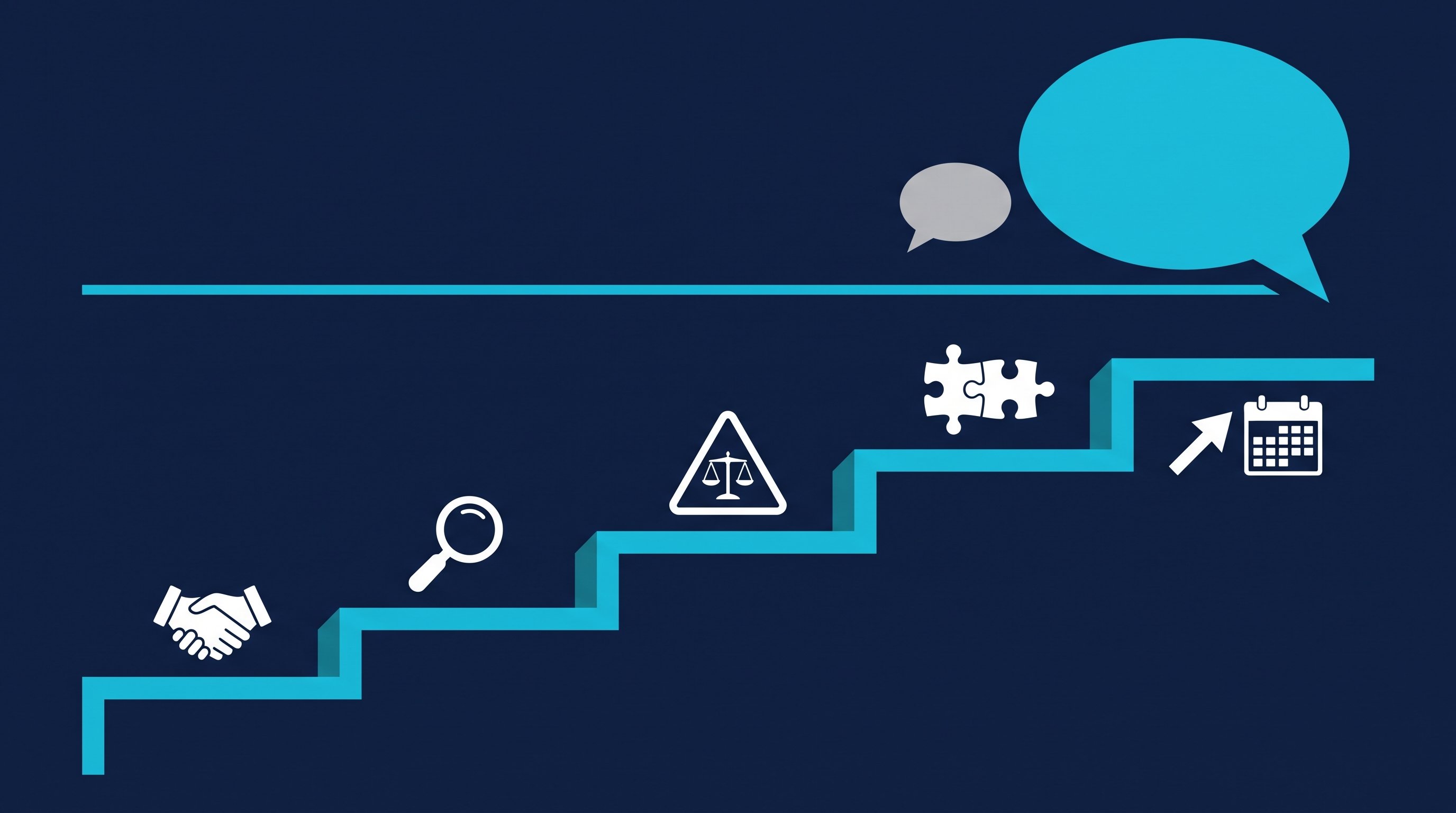
The meeting rarely comes from the first message. It comes once your contact has replied and a real topic is on the table in the chat. The path looks like this:
- Connection request with a short reason.
- First message after acceptance with a question that fits the role.
- Follow up if no reply comes.
- Read the reply and listen in the chat for one or two messages.
- Propose a discovery call: topic, length, two time slots.
- Confirm the meeting, with the goal and an invitation.
An example from coaching, after the contact has replied:
Hi Ms Krüger, thanks for connecting. You're building a second team in Leipzig right now. How are the new leaders settling in?
Honestly, it's bumpy. Two of my three team leads are new to the role.
I hear that a lot from fast-growing teams. Shall we talk about it for 20 minutes on video? I'll ask you where things get stuck, and afterwards you decide whether coaching fits. Tuesday at 10 or Thursday at 2? If neither works, pick a time here: [Link]
Two concrete times can be answered with one word. The booking link is the add-on, not the replacement. Why plain booking links on LinkedIn often go nowhere is explained in Why many LinkedIn meetings fall through.
Confirm the meeting in writing with the goal and the length. If you like, add a short customer example. Then the call starts with a head start in trust, as described in Why your offer does not persuade, but your trust-building does.
How it works by hand
This is what the work up to the discovery call looks like when you click everything yourself. The minutes come from two CompLeadly accounts in 2026. They are the measured execution time of the software per action and so a lower bound for manual work: the software pauses like a human when opening, reading and typing.
- Define your target customers and set up the search: once per target audience, not measured. How to describe your ideal customer is shown in Sales ICP.
- Open the profile and follow: about 1.5 minutes.
- Read the profile, find a reason, send the connection request: about 3 minutes.
- Check who accepted and write the first message: about 1.5 minutes per accepted contact.
- Follow up without a reply: about 1.2 minutes per follow-up.
- Withdraw pending requests: about 12 seconds per request.
- Read replies, propose a discovery call, confirm the meeting: your work, not measured.
- Prepare and run the call: your work, not measured.
Steps 2 to 6 repeat the same way for every contact. Steps 7 and 8 decide whether you sell. The whole acquisition process in six steps is shown in Customer acquisition: the process by hand and automated.
How it works with CompLeadly
CompLeadly is a desktop app that runs on your computer. It takes over the steps up to the reply. From the reply on, it's your turn, and that is exactly where the path to the discovery call begins.
- Target audience (you): A LinkedIn people search, a Sales Navigator search or an imported Excel list becomes the target audience.
- Profile visit and connecting (software): with or without a note, with a daily value per step.
- Opener (software): After acceptance, a first message goes out, with placeholders like the first name, but only if the chat is still empty.
- Follow-ups (software): A follow-up only goes out once your last message has gone unanswered for as many days as you set. If the contact replies, the automatic messages stop.
- Replies (you): With Smart Chat (add-on), your LinkedIn messages are in CompLeadly. You filter for unanswered chats, create categories and assign chats to colleagues. You write the meeting proposal yourself.
- Meeting (you): CompLeadly doesn't book meetings. The app's calendar plans when your workflows run. You put your booking link, for example from Calendly or HubSpot Meetings, into a message or a follow-up in the sequence.
Individual steps like connecting, opener and follow-up already run in the free version with basic features and daily limits, for example 2 connection requests, 1 opener and 1 follow-up per day, each step started individually. Full workflows and schedules start with Basic. You start with a 10-day trial with all features. Plans are on the pricing page. How founders and sales teams work with it is shown on the pages for founders and sales teams.
Time calculation
The table works through the clicking for 100 contacts you send requests to, up to the booked discovery call.
| Step | Minutes by hand | Minutes with CompLeadly | Time saved |
|---|---|---|---|
| Open and follow the profile | 1.5 | 0 | 1.5 |
| Read the profile, find a reason, send the connection request | 3 | 0 | 3 |
| Withdraw the pending request | 0.2 | 0 | 0.2 |
| First message after acceptance (per accepted contact) | 1.5 | 0 | 1.5 |
| Follow-up without a reply (per accepted contact) | 1.2 | 0 | 1.2 |
| Total for 100 contacts | 8 h 58 min | 0 min | 8 h 58 min |
| Per accepted contact | 21.5 min | 0 min | 21.5 min |
| Per booked meeting | 7 h 10 min | 0 min | 7 h 10 min |
Example calculation · Acceptance rate 25%, Booking rate 5%
Sample calculation. Assumptions: minutes per step are the measured execution time of the software from two CompLeadly accounts in 2026 (average per action: follow 90 seconds, visit and connect 180, first message 91, follow-up 69, withdraw 12), a lower bound for manual work. Acceptance rate of 25 percent as the midpoint of the 13 to 37 percent range measured across the audiences of these accounts. Discovery call rate of about 5 percent of accepted contacts, our own estimate, not counted. Withdrawing is applied to all contacted prospects and the follow-up to all accepted contacts, so both are upper bounds. With CompLeadly, 0 minutes per contact because the software runs these steps; the one-time setup of audience and messages was not measured and is not included. Replies, preparation and the call itself take the same time either way and are not included.
The rate varies a lot with the audience. In these accounts, requests to coaches were accepted at 12.6 to 31.8 percent depending on the region, requests to software and technology decision makers at 28.8 percent. For financial advisors we have no numbers of our own. Plug in your own numbers as soon as you have them.
The result: about seven hours of clicking go into every discovery call before it even begins. Otherwise that time is missing exactly where the selling happens: in the preparation and in the call. What the day looks like once the busywork is gone is described in Why I only need 30 minutes a day for outreach now.
Preparation in 10 minutes
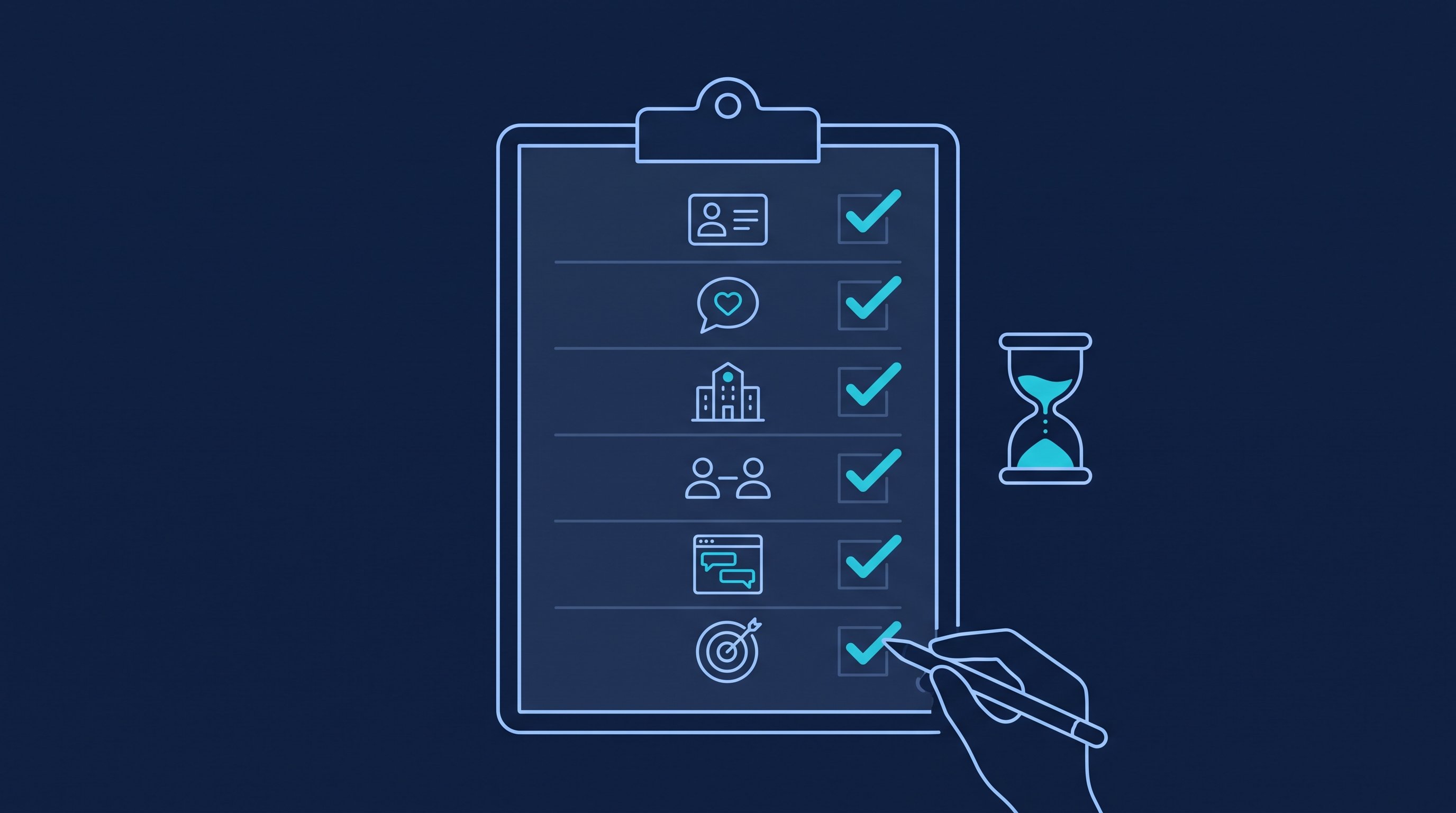
Ten minutes are enough if you know what you are looking for. More research feels thorough, but it rarely brings more to the call. Our checklist:
- Profile: Role, how long in the position, previous positions, About section. Someone new to the role usually wants to show results quickly.
- Posts and comments: What has the person written about in recent weeks? One sentence from that is your best opening.
- Company: Website, news, open positions. Job ads often reveal where things are on fire right now.
- Mutual connections: Who do you both know? A mutual acquaintance creates closeness, and sometimes a short question to them beforehand pays off. How that works is shown in LinkedIn mutual connection.
- Chat history: What has the person written to you? Their own words are the strongest basis for your first question.
- Three assumptions and one goal: Note three guesses about where the problem might be, and the next step you want.
You test the assumptions in the call. You don't present them.
The call in 5 phases
Good discovery calls follow a clear order. It gives you structure without the call sounding scripted.
- Set the frame. Thank them for their time, confirm the length, name the goal. For example: "I'd like to ask you a few questions so I understand where you stand. Afterwards I'll tell you honestly whether I can help. Does that work for you?" That yes makes the rest easier.
- Understand the situation. What does it look like today? Who is involved? What has already been tried? Here the other person talks, you listen.
- Problem and consequences. What does it cost if nothing changes? Time, money, nerves, employees? Only once the consequences are spoken out loud does an annoyance become a reason to act. How to build these questions is shown in SPIN Selling.
- Check the fit. Now you explain how you work, but only in relation to what you have heard. If it doesn't fit, say so. A clear no with a recommendation is remembered longer than a watered-down maybe.
- Next step. Agree on something concrete with a date while you are still in the call: a proposal, a demo, a second call with the managing director. "I'll get back to you" is not a next step.
The most important rule stands above all phases: the other person talks more than you. If you present in a discovery call, you learn nothing.
12 questions for coaches, financial advisors and SaaS
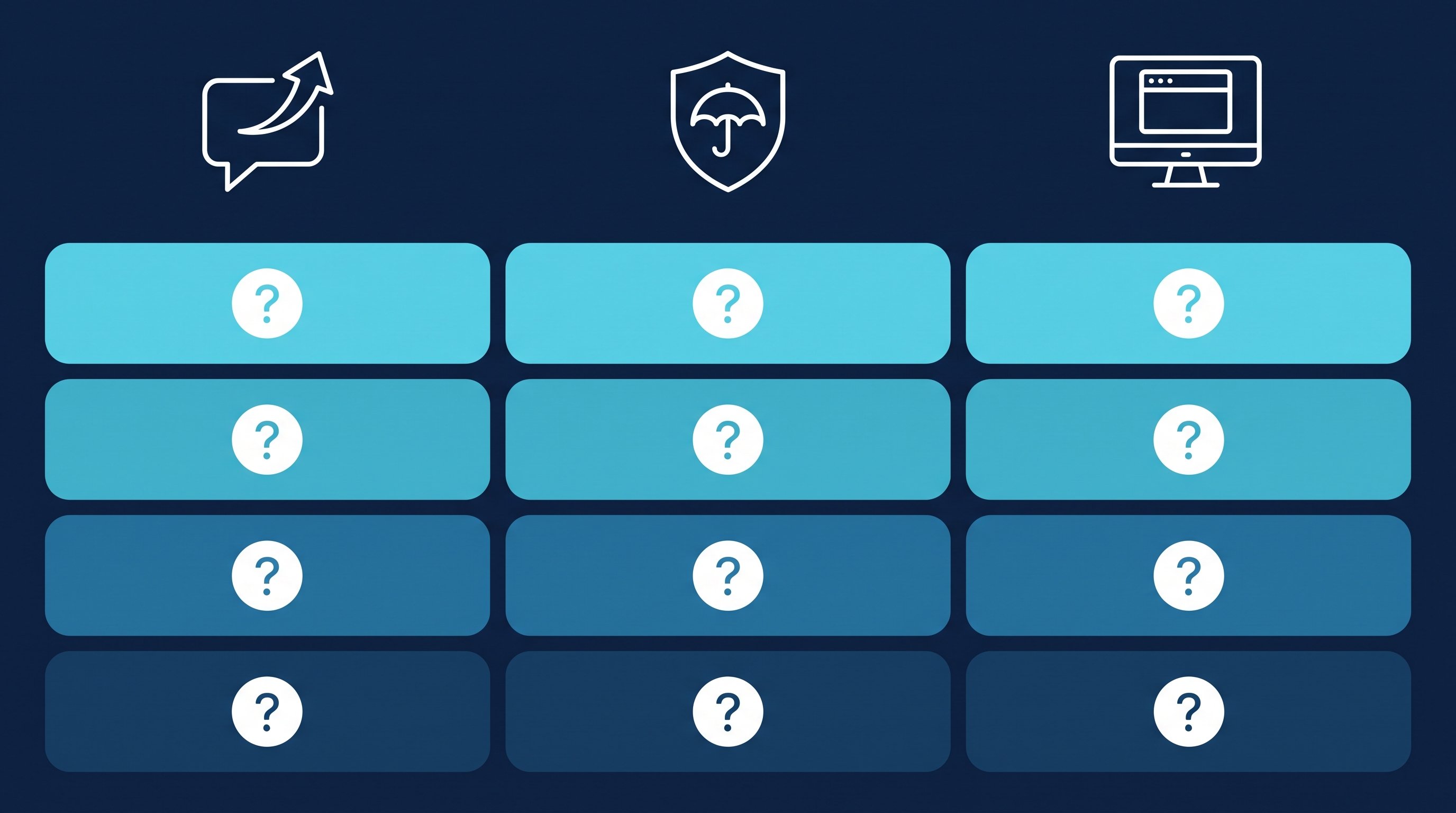
The phases are the same everywhere. The questions change with the audience. Here are four questions each for three industries, sorted by phase.
Phase | Coaches | Financial advisors and insurance brokers | SaaS |
|---|---|---|---|
Situation | How is your team set up today, and who leads whom? | How have you handled retirement planning and insurance so far? | How do you solve this today, with which tool or which spreadsheet? |
Problem | Where do you notice in day-to-day work that leadership gets stuck? | Where do you doubt whether your solution still fits your situation? | What annoys your team most about the current solution? |
Consequences | What happens if things are still the same in six months? | What would it mean for your family or your company if something happened tomorrow? | What does that cost you per month in time or revenue? |
Decision | Who decides on coaching at your company, and by when? | Who should be at the table for the decision? | Who else needs to have a say, and what does your selection process look like? |
A note on financial advisors: with money and family, trust counts more than speed. Only ask the consequences question once the conversation has warmed up. With SaaS it's the other way round: ask early about the decision path, or you will run three discovery calls with people who don't get to make the purchase.
Recruiting: the discovery call with candidates
In recruiting, the candidate is the person who decides. The discovery call clarifies whether a move makes sense for them at all.
- What do you like about your current role, and what is missing?
- What would a new position have to offer to make a move worth it?
- What does your timeline look like, and who has a say in the decision?
With your own Recruiter license, CompLeadly turns a Recruiter search, a pipeline or a saved search into the target audience. Connecting, opener and follow-ups run until the candidate replies. You hold the discovery call about reasons for switching yourself. Wording for every stage is in LinkedIn recruiting messages, the process is shown on the page for recruiters.
Job hunting: the introductory interview with a recruiter or hiring manager
As a job seeker, you reverse the roles. Your introductory interview is a discovery call too, and here too, whoever asks wins.
- What is the team working on right now, and where should the new person take the most off your plate?
- What is left undone while the position is open?
- How would you know after six months that the hire was the right one?
You can build the path to the conversation just like in sales: a people search for recruiters and team leads at the employers you want to work for becomes the target audience. Profile visit, connecting, opener and follow-up already run in the free version with its daily limits. For a small, targeted list, that is enough. Typical mistakes on the way there are in 10 common LinkedIn mistakes when job hunting.
After the call: follow-up
The best discovery call fizzles out if a week of silence follows. Three rules:
- Summarise the same day. Three points you heard, the agreed next step, the date. Summarising shows that you listened. A template for this is in the follow-up templates, template 3 "After a meeting".
- Write in the customer's words. If they talked about "chaos in onboarding", you don't write "process optimisation potential".
- If no reply comes, follow up. After a few working days, send a short reminder with the next step in the subject line. If someone didn't show up to the meeting at all, ask kindly the same day and suggest two new times.
On LinkedIn, it helps that the automatic follow-ups in the sequence already stopped with the first reply. Nobody gets a template after the call that no longer fits. In Smart Chat, you create a category like "Discovery call held" and see at a glance who is still waiting for your summary.
FAQ: discovery call
What is a discovery call?
A discovery call is the first meeting with a potential customer. It clarifies whether they have a problem you can solve and whether you are a good fit. At the end there is a concrete next step or an honest no. Coaches often call it a free initial consultation.
What is the difference between a discovery call and a demo?
The discovery call comes first and is about the customer: situation, problem, consequences, decision path. The demo comes afterwards and only shows the parts of your product that match what you heard in the discovery call.
Should a discovery call be free?
For coaches and consultants, the free discovery call is common and lowers the barrier. It remains a clarification, not consulting. Say up front what's included, and only deliver the solution in the paid engagement.
How do I book a discovery call on LinkedIn?
Connect and start a conversation first, then propose the meeting. Name the topic, the length and two concrete times, with the booking link only as an add-on. Confirm the meeting in writing with the goal and the length.
What questions do I ask in a discovery call?
Questions in four stages: about today's situation, about the problem, about the consequences if nothing changes, and about the decision path. The table above shows four examples each for coaches, financial advisors and SaaS.
Does CompLeadly book meetings?
No. On LinkedIn, CompLeadly takes over the steps up to the reply: profile visit, connecting, opener and follow-ups. Your contact books the meeting through your own booking link, for example from Calendly or HubSpot Meetings, which you put into a message in the sequence.